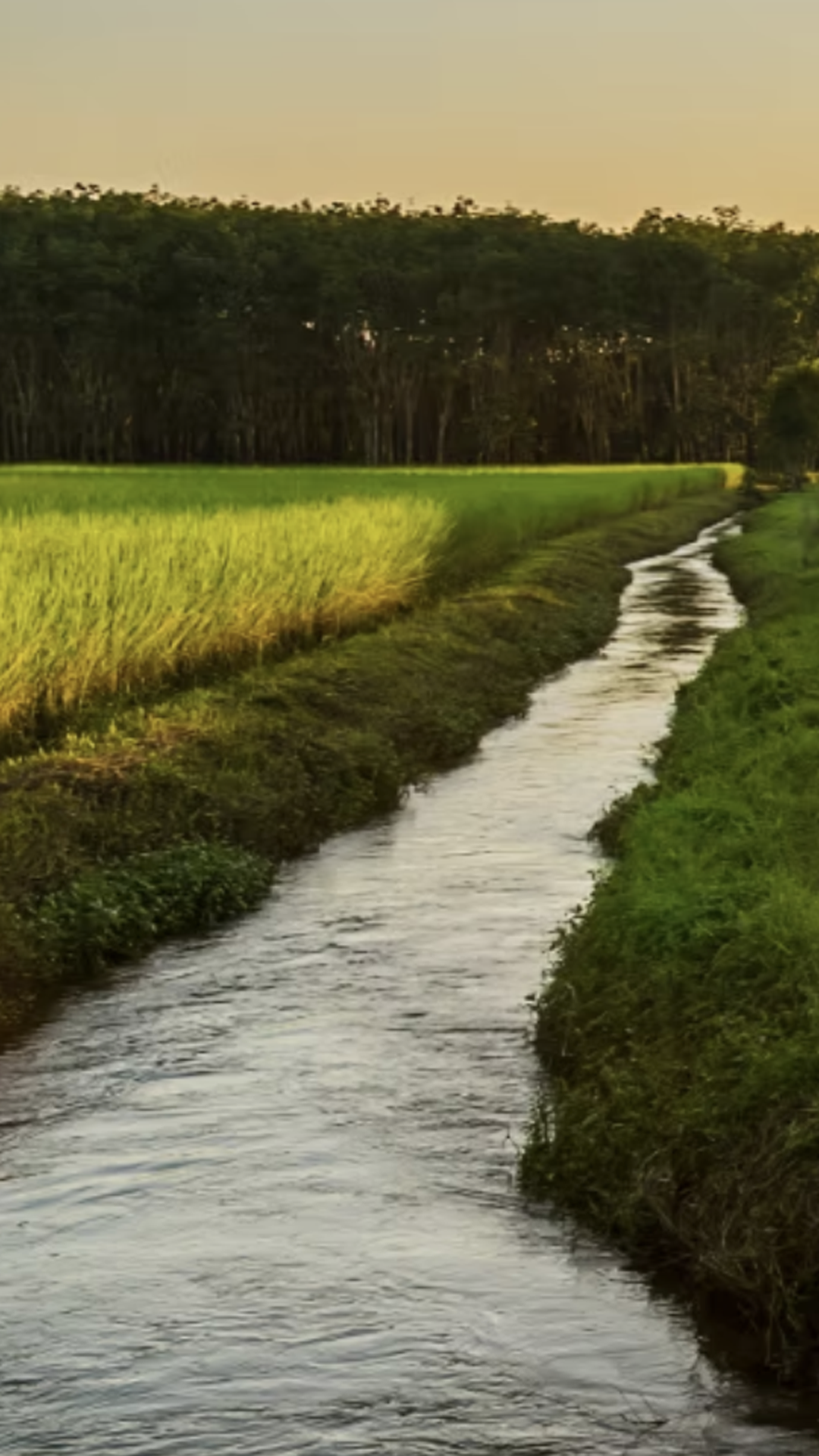
The Earth Pillar: Four Stories Proving Regeneration Works
July 24th, 2026
That's the whole premise behind Regeneration X. We built this because the people already doing the hard work of restoring what's broken deserve a bigger audience than an algorithm decides to give them — the farmers, founders, scientists, and neighbors quietly proving that decline isn't inevitable.
We're Gen X. We've spent a career watching problems get named more often than solved. So instead of another take on what's wrong, we go looking for proof of what's working...real land, real ledgers, real bodies, real communities, already regenerating.
We organize everything around four pillars Earth, Body, Economy, Community because regeneration was never a single fix. It's how systems, natural and human, actually work: interconnected, self-correcting, built to restore themselves if we stop getting in the way.
We're starting where nature always starts — the ground itself.
This first issue collects our earliest four Earth pillar spotlights: a fifth-generation rice farmer who saved his family's land by changing everything about how he farmed it; two strangers turned partners protecting 135,000 acres of Amazon rainforest; a German forester teaching an entire country to listen to what trees have known for 385 million years; and a couple who turned a dying 200-acre farm into one of California's most biodiverse, because they'd promised their dog a backyard.
Four different stories. One idea: nature already knows how to heal itself. We just have to pay attention.
Story 1 — Jim Whitaker
The farmer who rebuilt the family land after a foreclosure letter
Fifth-generation Arkansas rice farmer. Zero-grade farming + alternate wetting and drying cut water use and emissions 50%. Now certifies other farms through AgriCapture.
This Arkansas family has farmed the same land since 1890. What they figured out could change how the world grows rice.
Jim Whitaker is a fifth-generation farmer born and raised in McGehee, Arkansas. He, his brother, and their families own and operate Trinity Farms and Whitaker Grain — where the Whitakers have worked the same soil for 135 years.
But this story didn't start with environmentalism. It started with survival.
Jim was 16 when his father received a foreclosure letter from the bank during a historic drought. He never forgot it. When he and his brother Sam started farming on their own, they had a beginning FSA loan, the worst piece of ground available, and one conviction — the old way wasn't going to work.
So they changed everything.
Using zero-grade farming and a technique called alternate wetting and drying, Jim and his daughter Jessica built a system that cut water use and greenhouse gas emissions by 50% — while increasing yields and profitability. They took that story to the TED stage.
Then they didn't stop there. Jim partnered with AgriCapture to create a Climate-Friendly certification for rice farming. More than 30 neighboring farms are now certified. Their rice is sold through Great River Milling and supplies Ben's Original — proof the model scales.
Story 2 — Paul Rosolie & Julio Durand
Two strangers, 135,000 acres of Amazon rainforest
Founders of Junglekeepers — one arrived at 18 with nothing but a calling, the other had lived in the jungle his whole life.
There's a corner of the Peruvian Amazon called the Las Piedras River corridor — so remote, so dense with life, it still holds species unknown to science and uncontacted tribes who have never seen the outside world.
The same roads that open the world to wonder also open it to chainsaws. In 2009, a highway offshoot pierced this region. By 2013, satellite images told the story: clearings spreading from the road like a wound. Ancient trees falling for short-term profit.
Two men decided they weren't going to watch that happen.
Paul Rosolie first came to the Amazon at 18 — a restless, dyslexic kid from Brooklyn with no funding, no institutional backing, and an inexplicable pull toward the wild. He just kept coming back, drawn to this one stretch of river that felt like the most alive place on earth.
Juan Julio Durand was already there. Born into the Ese'Eja Indigenous community, JJ grew up with the Las Piedras as his home and teacher. He'd already begun quietly acquiring land along the river to protect it. Before there was an organization, before there was a name, JJ was doing the work.
When they found each other, something shifted. In 2015, they co-founded Junglekeepers.
The model is simple and replicable: purchase land ahead of logging operations — get there before the chainsaws do — then employ former loggers and illegal miners as trained forest rangers. People who know this forest better than anyone, now making a living protecting it instead of extracting from it.
Today Junglekeepers protects over 135,000 acres of primary Amazon rainforest. Their goal is 300,000 — a continuous corridor functioning as a long-term refuge for one of the most biodiverse places on the planet.
Story 3 — Peter Wohlleben
The forester who taught Germany to listen to trees
Author of The Hidden Life of Trees, founder of the Forest Academy. Teaches that forests regenerate through cooperation, not competition.
Somewhere in Germany's Eifel region, there's a tree stump that should be dead.
No bark. No branches. No leaves. By every visible measure gone. But beneath the soil, the surrounding trees have been quietly feeding it for centuries through their root network keeping it alive. Not out of sentiment but out of collective intelligence. The stump's root system is too valuable to the community to let go.
Peter Wohlleben found that stump. And it changed everything he thought he knew about how living systems work.
A forester who walked away from industrial forestry after the data showed him what extraction actually costs, Wohlleben spent decades inside ancient forests learning what cooperation really looks like at full scale. What he found wasn't soft science, it was a operating system. Trees communicate danger through chemical signals in the air. They transfer nutrients through underground fungal networks to neighbors who are struggling. They moderate temperature, generate rainfall, and buffer against climate extremes, but only when they function as a community. A single tree can't do any of it alone.
His words are worth sitting with: "A tree is not a forest. If every tree were looking out only for itself, then quite a few of them would never reach old age."
We built economies around the idea that competition is nature's deepest law. Wohlleben spent thirty years in actual nature and came back with the opposite message. Cooperation isn't the exception in healthy systems. It's the architecture. The forest doesn't run on scarcity. It runs on an economy of care routing resources toward what's struggling, protecting what's vulnerable, investing in root systems that won't pay off for decades.
The health of the soil, the resilience of the network, the wellbeing of every member is one system. You can't extract from one layer without weakening all the others. We've been treating our communities, our economies, and our ecosystems as separate problems. The forest has been showing us for 385 million years that they're the same problem.
Wohlleben put it simply: cooperation is better than competition. Trees figured that out long before we did.
Story 4 — John & Molly Chester
They got evicted because of their dog. So they bought a dying 200-acre farm.
Apricot Lane Farms, subject of The Biggest Little Farm. Solved pest problems with more life, not chemicals — ducks, owls, cover crops.
In 2011, John and Molly Chester, a filmmaker and a chef, left Los Angeles with no farming experience and a rescue dog named Todd. They purchased 214 acres of land that, in John's words, was like "a bank that had been robbed." Decades of extractive farming had stripped the soil of biology, compacted the earth, and drained it of life.
What they built next changed how a generation thinks about food.
Apricot Lane Farms in Moorpark, California is now a 234-acre regenerative ecosystem growing over 200 varieties of fruits and vegetables, and raising cows, sheep, pigs, chickens, and ducks with deep care and respect. The farm is certified Organic, Biodynamic, and Regenerative Organic Certified (ROC), the gold standard in humane, earth-first agriculture.
Their secret? Stop fighting nature. Start learning from it. Chickens follow cattle to break up manure and control pests. Cover crops feed the soil and the animals. Every element serves multiple purposes. The whole becomes greater than its parts.
John documented the entire 8-year journey in the award-winning film The Biggest Little Farm — one of the most powerful on-ramps into regenerative thinking you'll ever watch.
Nature wrote the blueprint for regeneration. We just stopped following it.
The Body Pillar: Rest, Reconnection, and Redesign
August 6th, 2026
Last week we started with Earth, the ground itself. This week we turn to the body, because the same logic applies. Soil that's compacted, overgrazed, and stripped of nutrients stops regenerating until you change how you treat it. A body pushed past its limits, disconnected from community, and deprived of sleep does the same thing.
Regeneration X exists to prove decline isn't inevitable for land or for people. This is our Body pillar debut: four stories built around one idea that keeps surfacing across all of them your body isn't broken. It's mismatched. It was built for a world that doesn't exist anymore, and reconnecting it to what it actually needs is often the fastest path back.
We look at a longevity researcher who found the secret to healthy aging in a Greek island's daily rituals, not a supplement stack. A journalist who traced depression and anxiety back to disconnection rather than pure brain chemistry. A Harvard evolutionary biologist who reframed chronic disease as a design problem, not a personal failure. And a Navy SEAL turned physician who discovered the toughest people on earth needed rest, not more grit.
Four different diagnoses. One prescription: give the body back what it evolved to need.
This Issue: Four Body Pillar Stories
Story 1 — Dan Buettner & the Island of Ikaria
The Greek island where people forget to die
Buettner's Blue Zones research found that Ikaria's remarkable longevity isn't a diet or a supplement — it's daily movement, purpose, and a community structure that doesn't let anyone age alone.
He went home to Ikaria to die and forgot how.
In 1976, Stamatis Moraitis received a terminal lung cancer diagnosis from nine different doctors. Given six to nine months, he made a simple, practical decision: return to his native Greek island so his family wouldn't bear the cost of an American funeral.
No chemo. No clinical trials. No protocol.
Just clean air. Garden soil under his nails. Old friends arriving each afternoon with a bottle of local wine. Church on Sundays. Afternoon naps. No alarm clocks. No deadlines. No rush.
Six months passed. Then a year. Then decades.
His cancer went into remission. He planted a vineyard not because he expected to taste it, but so his wife would have something after he was gone. He tasted it. Many times over. Stamatis Moraitis died peacefully in 2013 at the age of 102.
When asked his secret, he shrugged. "I don't know. I guess I just forgot to die."
His story isn't just medical. It's a mirror. Modern life the pace, the isolation, the processed everything may be as dangerous as any diagnosis. What healed Stamatis wasn't exotic or expensive. It was community, purpose, movement, and belonging. Things we once had by default. Things we now have to consciously choose.
Story 2 — Johann Hari
Depression and anxiety as disconnection, not just chemistry
Author of Lost Connections. Reframes mental health struggles around nine causes of disconnection — from meaningful work, people, nature, and values — and makes the case that reconnection is medicine.
For decades we've been told depression is simply a chemical imbalance, fix the brain, fix the feeling. Journalist Johann Hari doesn't buy that it's the whole story, and after years of research and his own lifelong struggle with depression, he makes a compelling case for why.
In his book "Lost Connections," Hari lays out nine causes of depression and anxiety and most of them aren't biological. They're about disconnection: from meaningful work, from other people, from nature, from status and respect, from a hopeful future, and from values that actually fit who we are.
When we're isolated, overworked in jobs that feel meaningless, disconnected from the natural world, and chasing "junk values" handed to us by advertising and status games, our minds respond the way they're supposed to. Distress isn't a malfunction. It's often a signal.
Mental health isn't separate from physical health, it's foundational to it. Chronic stress, isolation, and a sense of meaninglessness show up in our sleep, our immune systems, our energy, our relationships. You can't out-supplement a life that's fundamentally disconnected from what humans actually need to thrive.
Story 3 — Daniel Lieberman
Mismatch diseases: why your body isn't broken, just out of sync
Harvard evolutionary biologist. Argues that chronic disease is largely "dysevolution" — modern environments suppressing a body that already knows how to be healthy.
Your chronic back pain. Your blood sugar struggles. Your flat feet, your insomnia, your anxiety. Science has a name for all of it: mismatch disease.
Harvard evolutionary biologist Daniel Lieberman has spent his career studying what happens when ancient biology collides with a modern world and his conclusion should change how you see your own body forever.
For 200,000 years, the human body was shaped by daily movement, intermittent food scarcity, natural light, deep social bonds, and earth underfoot. Evolution is slow and meticulous. It built something extraordinary.
Then industrialization rewrote the environment in 200 years. Chairs designed for maximum stillness. Processed calories available everywhere, always. Artificial light at midnight. Screens instead of faces. Cushioned shoes instead of ground.
The body didn't fail. The environment failed the body.
Lieberman calls what followed "dysevolution”, the loop where we treat symptoms without addressing causes, pass the same environment to the next generation, and watch the disease deepen. We give insulin for diabetes but keep the sugar supply. We prescribe orthotics for flat feet built by the shoes that caused them.
Here's where it gets hopeful.
If chronic disease is caused by environmental mismatch, then changing the environment can interrupt — and even reverse — the disease. Not always with drugs. With conditions.
Walk more. Sit on the floor sometimes. Eat closer to the source. Protect your sleep like your ancestors had to. Put your feet on actual ground.
And share this framework with someone who needs it. Because the most regenerative thing you can do is help the people around you understand: this isn't personal failure. It's a design problem.
Design problems can be solved.
Story 4 — Dr. Kirk Parsley
The Navy SEAL doctor who discovered rest is the real force multiplier
Former SEAL turned physician. Spent years treating elite operators for what looked like a willpower problem and turned out to be a sleep problem.
At 17, Kirk Parsley joined the Navy SEALs. He served through the first Gulf War, then left in 1994 to go to medical school and came back to the SEAL teams as their physician.
For years, his job was to keep the most elite operators in the world running at peak performance through near-continuous combat deployments. What he found wasn't a willpower problem. It was a sleep problem. Eight years of nearly continuous combat were weighing on the SEALs, and Parsley was tasked with optimizing men who were taught their entire careers that exhaustion was just the cost of the mission.
He didn't have the luxury of easy fixes. Working in austere environments with limited medical support, he had to build solutions that relied on almost no pharmaceuticals, supplements, or gadgets, just a return to the basics human biology actually requires. Sleep was the foundation underneath all of it.
That experience reshaped how he sees health entirely. Parsley believes many of the diseases and disorders we accept as "inevitable" in modern life are really unnecessary complications of poor sleep, a toxic environment, and stress we were never built to absorb. Not a personal failure. A design mismatch and one we can correct.
Today, he consults for corporations and professional athletes and travels the world teaching the same lesson he learned protecting the most elite soldiers on the planet: rest isn't the enemy of performance. It's the source of it.
Nature wrote the blueprint for regeneration. We just stopped following it.
sign up for our newsletter
or just reach out